
My research explores how planets form, survive, and can be detected in binary and multiple star systems, and how stellar multiplicity shapes the wider planet population. I combine eclipse-timing, transit, and radial-velocity observations with dynamical modelling and population statistics.
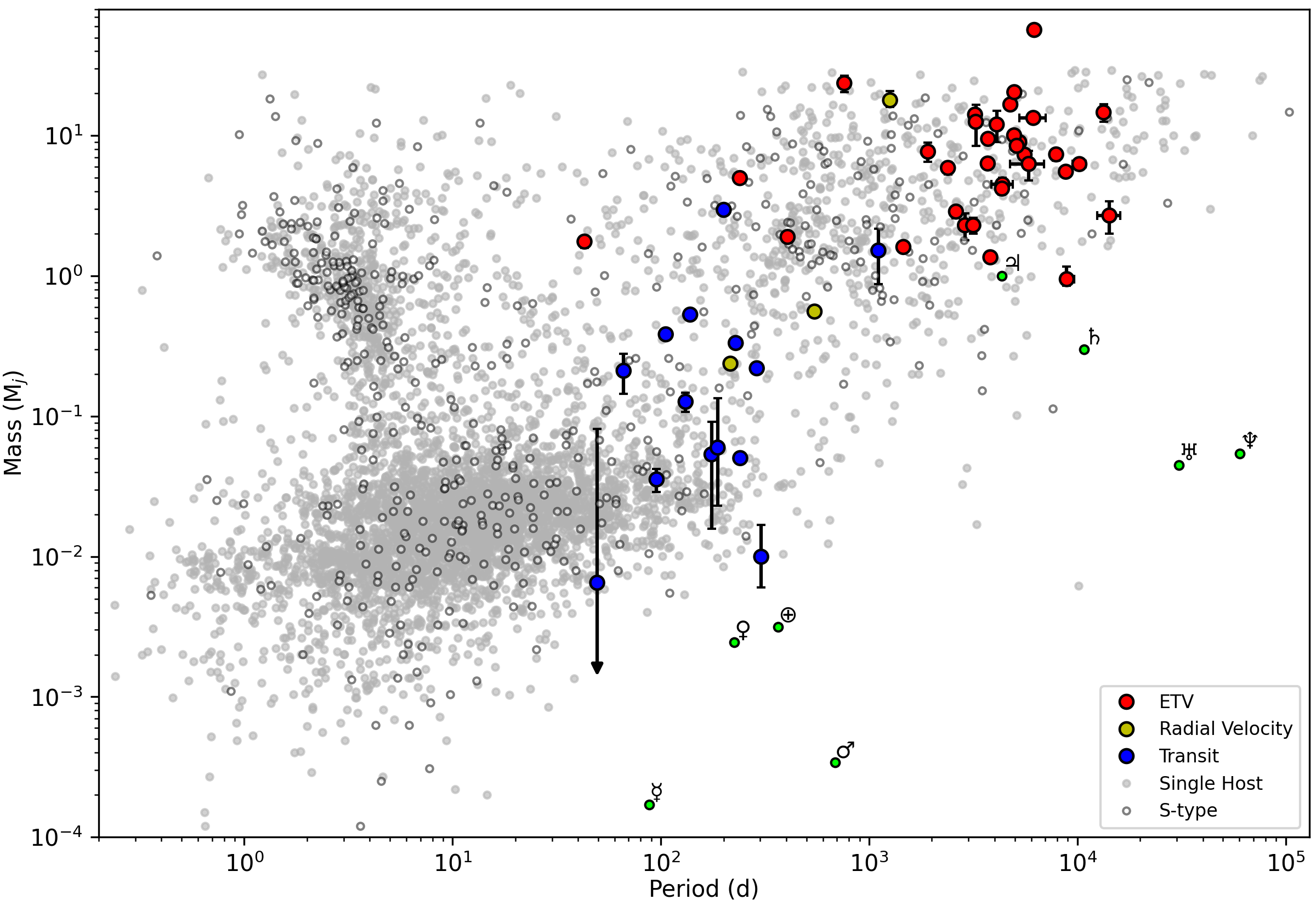
Masses and orbital periods of known circumbinary planets and brown dwarfs (colored by detection method), compared with planets around single stars, S-type planets in multiple-star systems, and the Solar System planets. Figure 1 from Esmer & Daylan (2025).
Current Research
How common are Earth-like planets?
With the ExoLab group (PI: Ian Crossfield), I work on occurrence-rate (η⊕) estimates for Earth-like planets as part of the transiting-exoplanet science case for the Lazuli Space Observatory.
The architecture of the TOI-1233 system
With the Astromusers group (PI: Tansu Daylan), I am revisiting the physical architecture of the multi-planet system TOI-1233, combining space-based photometry with radial-velocity measurements to refine the planets’ properties.
Planets orbiting one star of a binary (S-type)
Together with a PhD student, I study the dynamical stability of planets orbiting a single star within a binary system, and where such planets can survive long term.
Circumbinary planets and brown dwarfs with TESS
Building on Esmer & Daylan (2025), I am extending the TESS eclipse-timing survey to constrain how often planets and brown dwarfs orbit eclipsing binaries.
Transit Timing and Exoplanet Characterization
Transit timing variations (TTVs) can reveal additional planets, orbital decay, or tidal interactions in known exoplanet systems. I have contributed to transit-timing studies of individual systems such as HAT-P-19 and WASP-43 b, as well as homogeneous analyses of 10 and 16 exoplanet systems, with a particular focus on ephemeris determination and timing analysis (Baştürk et al. 2020, 2022; Davoudi et al. 2021; Yalçınkaya et al. 2024).
Eclipsing Binaries and Stellar Multiplicity
Precise physical parameters of eclipsing binaries are the foundation for interpreting their timing variations. I have contributed to combined spectroscopic and photometric analyses of eclipsing binaries such as V566 Oph, V972 Her, and RR Dra (Selam et al. 2018; Şenavcı et al. 2022), and to the characterization of a hierarchical quadruple system, TIC 263930790, revealed through eclipse timing variations and radial velocities (Özavcı et al. 2026).
Circumbinary Companions and Eclipse Timing
Eclipse timing variations (ETVs) offer a way to detect planetary and substellar companions orbiting eclipsing binaries. My work combines photometric observations, light-curve modeling, eclipse-timing analysis, and numerical simulations to characterize such systems and to test whether proposed companions are dynamically viable. These studies range from constraining the physical properties of HW Vir (Esmer et al. 2021) and identifying two additional candidate circumbinary planets around Kepler-451 (Esmer et al. 2022), to showing that only low-eccentricity, two-companion configurations of NY Vir remain dynamically stable (Esmer et al. 2023).
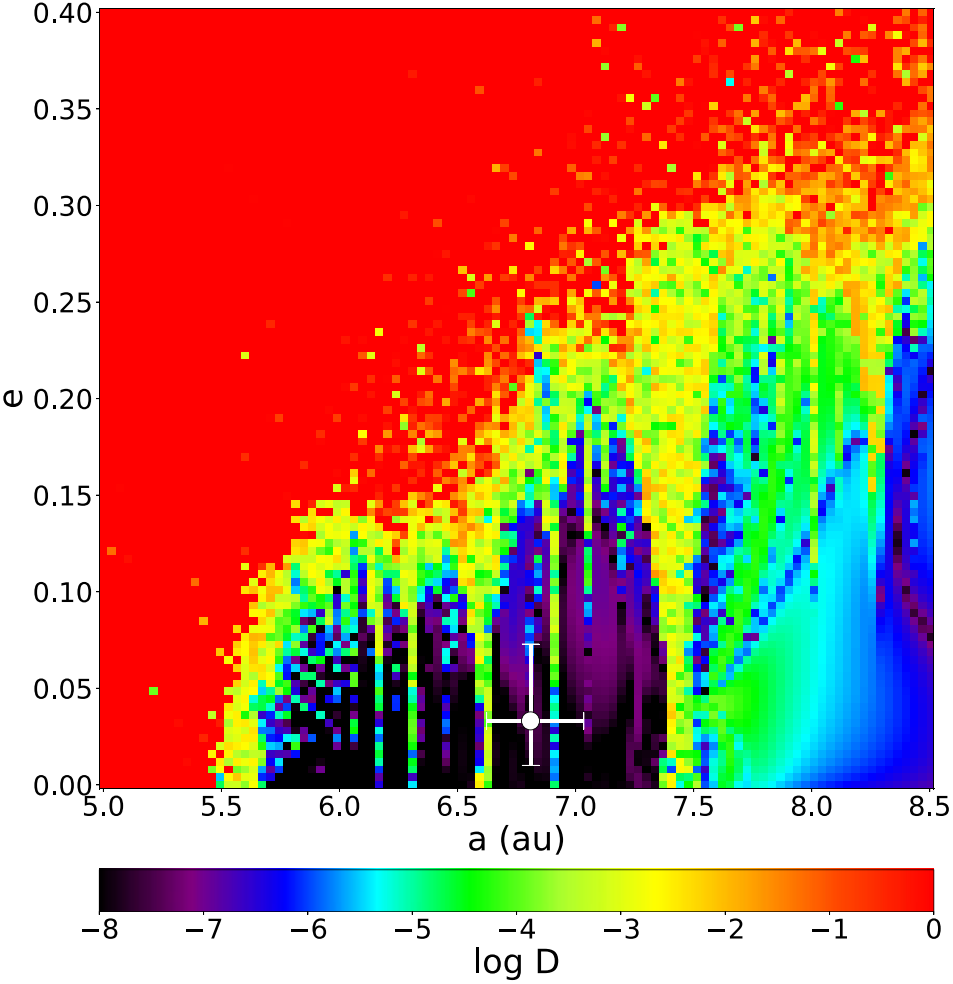
Dynamical stability map of the proposed circumbinary companions of NY Vir. Figure 4 from Esmer et al. (2023).
Building on these case studies, we analyzed 152 detached eclipsing binaries observed by TESS and used simulations to quantify how detectable circumbinary planets and brown dwarfs are, providing a basis for survey completeness and occurrence-rate estimates (Esmer & Daylan 2025).
Observing Tools and Instrumentation
To support observations with small and meter-class telescopes, I have contributed to open tools for preparing photometric observing maps (ObsMap; Yalçınkaya et al. 2024) and for observation planning (ObserPy; Güler et al. 2025). As a member of the Ankara University Observatory technical team (2015–2022), I supported telescope installation, maintenance, observing operations, and student training, and contributed to the description of the T80 telescope and its focal-plane instruments (Yörükoğlu et al. 2023).